
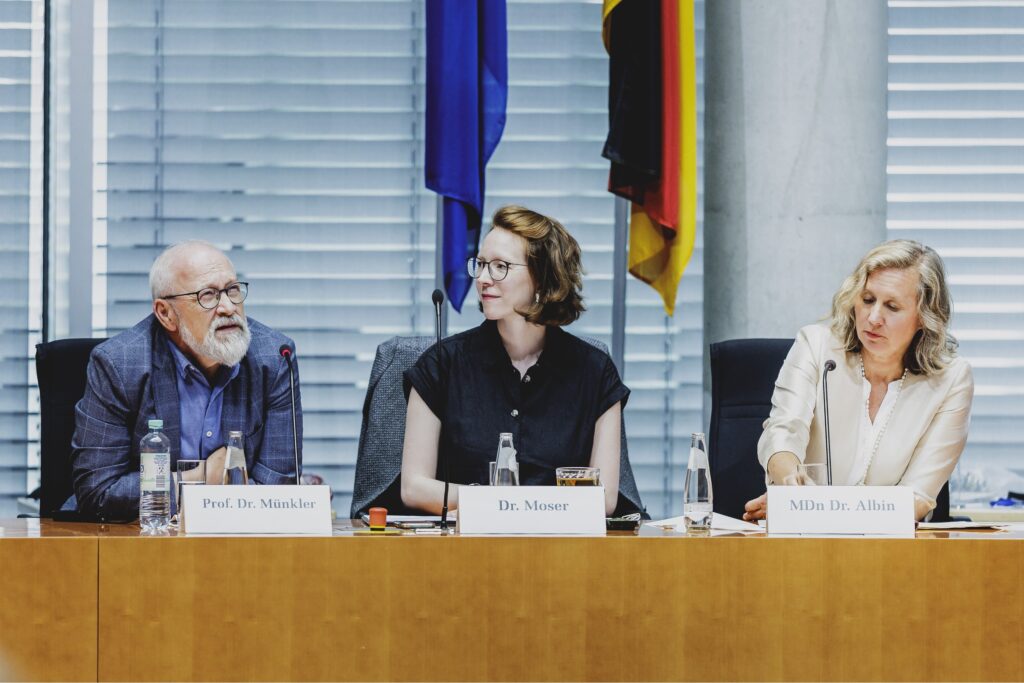
On 8th July 2025, Dr. Carolyn Moser [1], Dr. Benedikta von Seherr-Toß [2] and Prof. Dr. phil. Herfried Münkler [3] came together with members of the German parliament to discuss the future of European security and defence policy and sharing their expertise from science and practice.
In this blog post, we highlight three take-aways of their statements and the subsequent discussion.
- Cooperation does not compromise sovereignty but benefits it.
Over the past years, the aim of sovereignty has often been referred to as a reason for dealing with defence matters on a national level, rather than pursuing a European strategy. Dr. Moser suggests rethinking sovereignty. In her words, a common European defence does not a threaten national sovereignty but enables it.
Prof. Münkler supports this perspective, describing how Europe risks becoming the “doormat of the emerging empires”.
2. It is time to devise an appropriate strategy for a new world order.
According to Prof. Münkler, international politics can no longer rely on a rule-based order. Instead, today’s world politics are driven by power, which goes along with a narrowed time frame for reaction and thereby touches on one of the most fundamental principles of established democracies.
In view of the increasing number of initiatives in the defence industry, Prof. Münkler argues that a strategy should be found before money is spent. Dr. von Seherr-Toß agrees with this point of view but deems a cultural shift necessary. As an alternative to solo efforts, she wants to search for ways to open political projects to partners. Meanwhile, it is becoming increasingly difficult to get all 27 member states on board.
3. Homework for Parliamentarians: Cooperation.
As Dr. Moser puts it, the European Commission’s latest initiatives in the defence industry sector are establishing a new strand of defence policy in the European Union. The European Parliament and the national parliaments should therefore use existing forums to exercise their right of parliamentary control.
As an example, she refers to the Parliamentary Conference which meets regularly but, in her opinion, lacks a profound exchange. If the parliamentarians at both levels do not work together, they risk a deficit in accountability, which raises not only legal but legitimacy issues. In addition, she advises to create new channels and forums to exploit the potential of parliamentary control and ensure that all processes are covered.
The challenge will be to create channels that are applicable in the power-driven world described by Prof. Münkler.
You can watch the whole debate in German at this link.
[1] Dr. Carolyn Moser heads the research group ENSURE at the Max-Planck-Institute for Comparative Public Law and International Law in Heidelberg.
[2] Dr. Benedikta von Seherr-Toß is General Director for Peace, Security and Defence in the European External Action Service.
[3] Prof. Dr. phil. Herfried Münkler is Professor Emeritus for Political Science at Humboldt University in Berlin.